
Por MEDIOS AIPS
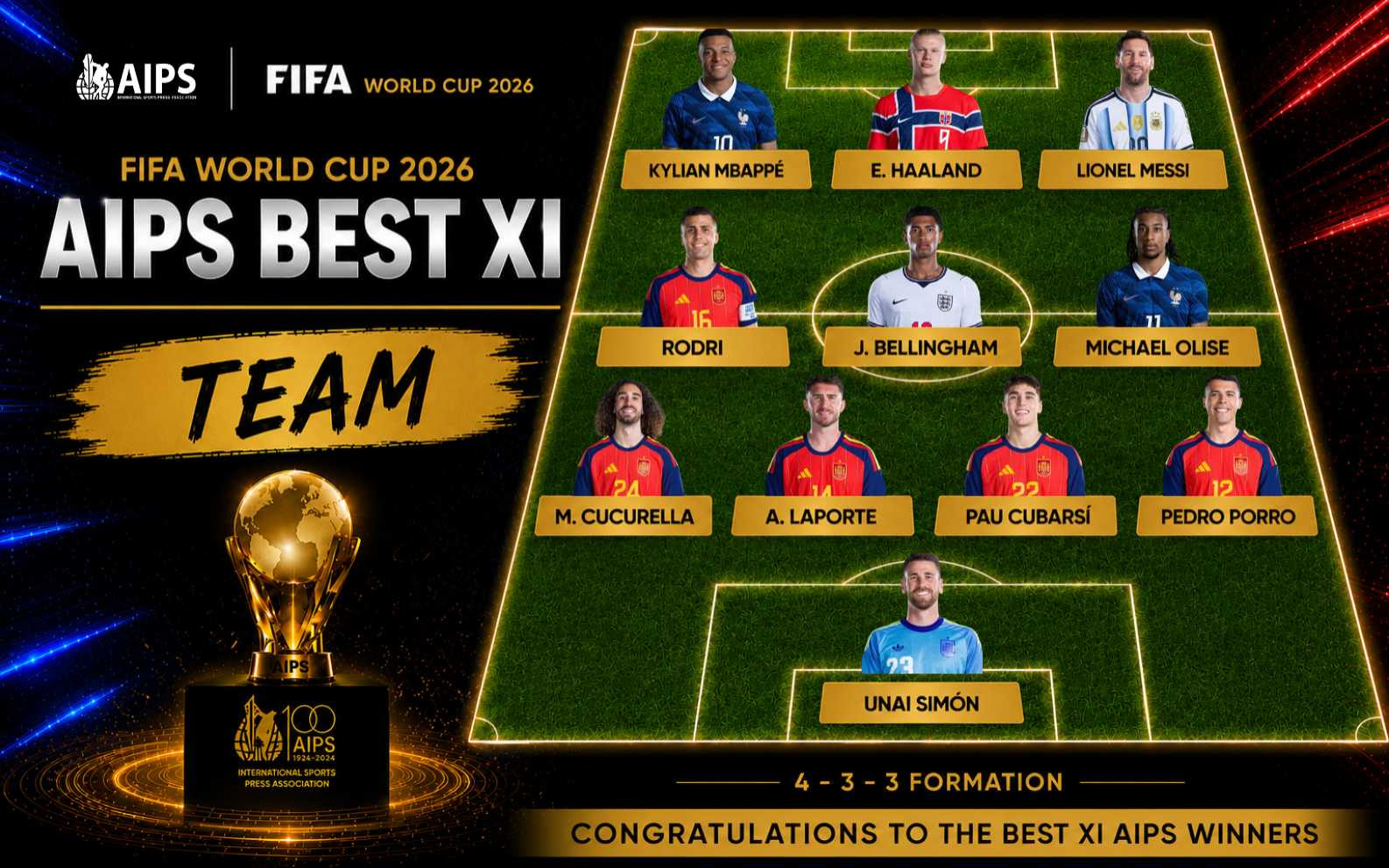
LAUSANA, 29 de julio de 2026 – La Asociación Internacional de Prensa Deportiva (AIPS) ha publicado su once ideal para la Copa Mundial de la FIFA 2026, seleccionado por 370 periodistas de 115 países.
La campeona España, que venció a Argentina por 1-0 el 19 de julio para alzarse con su segundo título mundial, dominó la plantilla con seis jugadores, la mayoría en defensa. Un claro ejemplo de la abrumadora superioridad defensiva de La Roja a lo largo de un torneo en el que mantuvo su portería a cero en siete de los ocho partidos y solo encajó un gol en 750 minutos de juego.
FORMACIÓN : 4-3-3
PORTERO
Unai Simón (España) : Sus siete porterías a cero en ocho partidos en la edición de 2026 constituyen la mayor cantidad en una sola Copa del Mundo. El jugador de 29 años también estableció un récord al no encajar goles en 650 minutos en Mundiales entre su última aparición en Qatar 2022 y el partido de cuartos de final de España contra Bélgica en la edición de 2026. Simón obtuvo 1221 puntos, superando al caboverdiano Josimar “Vozinha” José Évora Dias (917).
DEFENSORES
Pedro Porro (Lateral derecho – España): La impresionante combinación de solidez defensiva e instinto ofensivo de Porro resultó muy efectiva en el Mundial de 2026. Marcó dos goles en cinco partidos, fue clave para mantener la portería a cero en cuatro ocasiones y fue elegido mejor jugador del partido en la semifinal contra Francia. El jugador de 26 años acumuló 1401 puntos como lateral derecho, superando a Achraf Hakimi de Marruecos (907).
Pau Cubarsí (Defensa Central – España): Con 19 años, es el jugador más joven de la plantilla tras acumular la mayor cantidad de puntos en la posición de defensa central (1194). Jugó con aplomo, madurez y liderazgo impropios de su edad y fue uno de los dos únicos jugadores que completaron los 750 minutos de España en el torneo. Realizó 671 pases, la segunda mayor cantidad en la historia de los Mundiales, y fue nombrado Jugador Joven del Torneo por la FIFA.
Aymeric Laporte (Defensa Central – España): Colíder en intercepciones en el Mundial de 2026, la dupla formada por Laporte y el joven Cubarsí fue sencillamente excepcional. El jugador de 32 años registró el tercer mayor número de pases completados en el torneo (618), solo por detrás de sus compañeros Cubarsí (668) y el centrocampista Rodri (790). Fue el pilar de la defensa que menos goles encajó en la historia de la Copa del Mundo, y entre sus impresionantes estadísticas destacan 18 duelos aéreos ganados y 1 asistencia.
Marc Cucurella (Lateral izquierdo – España): Al igual que Cubarsi, Cucurella disputó todos los minutos de la trayectoria de España en el Mundial de 2026, demostrando su incansable trabajo, su gran sentido de la posición y su aguda inteligencia táctica. Partido tras partido demostró su indispensabilidad en la defensa más sólida del torneo, siendo prácticamente imposible superarlo con el balón. Conocido también por su vocación ofensiva, el jugador de 27 años dio dos asistencias en la victoria de La Roja por 3-0 sobre Austria en dieciseisavos de final. Cucurella obtuvo 1621 puntos en la votación del Once Ideal de la AIPS, superando al portugués Nuno Mendes (760).
CENTROCAMPISTAS
Jude Bellingham (Inglaterra): Bellingham lideró la votación en la categoría de mediocampistas con 965 puntos tras guiar a Inglaterra a la medalla de bronce en el torneo y ganar cuatro premios al Jugador Más Destacado del Partido. El jugador de 23 años anotó siete goles, la mayor cantidad de goles de un mediocampista en una Copa del Mundo, y ahora ostenta el récord de más goles en una sola edición de la Copa del Mundo por un inglés. Sus cruciales dobletes contra México en octavos de final y contra Noruega en cuartos de final lo convirtieron en el primer jugador desde Maradona en 1986 en marcar dos goles en partidos de eliminación directa consecutivos. Bellingham quedó tercero en la votación del Jugador Más Destacado del Torneo de la AIPS.
Rodrigo “Rodri” Hernández Cascante (España): Con 924 puntos, Rodri quedó por detrás de Bellingham. El mediocampista defensivo de 30 años fue el alma del brillante mediocampo español y se alzó con el Balón de Oro de la FIFA. Entre sus estadísticas en el torneo destacan los 790 pases completados, 152 más que su récord anterior de pases exitosos en un Mundial, establecido en Catar 2022.
Michael Olise (Francia): A sus 24 años, estableció un nuevo récord de asistencias en una sola Copa del Mundo. Realizó siete asistencias en el Mundial de 2026, superando las seis de Pelé en 1970. La mitad de los goles de Mbappé fueron gracias a las asistencias de Olise. Fue el creador de juego fundamental para Les Bleus, con una visión y creatividad increíbles que lo convirtieron en uno de los líderes del torneo en la generación de oportunidades de gol.
DELANTEROS
Kylian Mbappé (Extremo izquierdo – Francia): Mbappé fue elegido como el mejor delantero del Mundial de 2026 por la AIPS tras obtener 1038 puntos, superando a Lionel Messi (812) y Erling Haaland (669). El jugador de 27 años marcó 10 goles cuando Francia alcanzó su tercera semifinal consecutiva de la Copa Mundial de la FIFA 2026, finalizando en cuarto lugar. Revalidó su título de Bota de Oro, convirtiéndose en el primer jugador en ganar el premio al máximo goleador del torneo dos veces, y batió el récord histórico de goles en la Copa Mundial con un total de 22 goles en 22 partidos a lo largo de tres torneos.
Lionel Messi (Extremo Derecho – Argentina): El jugador de 39 años llevó a Argentina a la final del Mundial prácticamente en solitario con su magia, ganando el premio al Jugador Más Destacado del Partido cinco veces, la mayor cantidad para cualquier jugador en el torneo. Registró ocho goles y cuatro asistencias en ocho partidos con La Albiceleste para convertirse en el jugador con más goles en la historia de los Mundiales (21) y el jugador con más asistencias en su carrera en un Mundial (12) . Es el primer jugador en la historia de los Mundiales en marcar en nueve partidos consecutivos y en seis partidos de eliminatorias consecutivas. Fue coronado Jugador Destacado del Torneo por la AIPS.
Erling Haaland (Delantero centro – Noruega): Haaland anotó siete goles en cinco partidos, llevando a Noruega a los cuartos de final de la Copa del Mundo por primera vez. A pesar de la derrota final de su equipo ante Inglaterra, Haaland brilló en su debut mundialista, convirtiéndose en el máximo goleador debutante del torneo desde Grzegorz Lato, quien también anotó siete goles para Polonia en Alemania 1974. Los siete goles del jugador de 26 años llegaron con tan solo 18 disparos, lo que representa el mejor porcentaje de conversión en una sola Copa del Mundo desde 1986, según OptaJoe. Todos los goles se produjeron en sus primeros cuatro partidos, con un promedio de un gol cada 51 minutos.
CÓMO VOTARON LOS COMPAÑEROS Los miembros de AIPS, junto con los participantes de la línea directa de la Copa Mundial de AIPS, fueron invitados a conformar el equipo ideal del torneo a partir de una lista de más de 50 nominados, todos seleccionados por su desempeño a lo largo de la Copa Mundial.
Los participantes seleccionaron a sus tres mejores jugadores para cada categoría. La primera opción recibió 5 puntos, la segunda 3 puntos y la tercera 1 punto.
El once ideal de la AIPS, con una formación 4-3-3, está compuesto por los jugadores mejor clasificados en cada posición: 1 portero, 1 lateral izquierdo, 2 centrales, 1 lateral derecho, 3 centrocampistas y 3 delanteros.
A continuación se muestran los resultados completos de la encuesta AIPS Best XI:
PORTERO
Simón Unai (España) – 1221 puntos de 325 votantes
Évora Dias Josimar “Vozinha” José (Cabo Verde) – 917 puntos de 285 votantes
Martínez “Dibu” Emiliano (Argentina) – 566 puntos de 216 votantes
Bounou Yassine (Marruecos) – 434 puntos de 188 votantes
Gill Orlando (Paraguay) – 148 puntos de 80 votantes
DERECHA
Porro Pedro (España) – 1401 puntos de 343 votantes
Hakimi Achraf (Marruecos) – 907 puntos de 293 votantes
Koundé Jules (Francia) – 562 puntos de 252 votantes
Cancelo João (Portugal) – 302 puntos de 150 votantes
Alex Freeman (EE. UU.) – 104 puntos de 54 votantes
DEFENSA CENTRAL
Cubarsí Pau (España) – 1194 puntos de 288 votantes
Laporte Aymeric (España) – 459 puntos de 155 votantes
Upamecano Dayot (Francia) – 446 puntos de 166 votantes
Martínez Lisandro (Argentina) – 364 puntos de 132 votantes
Romero Cristian (Argentina) – 217 puntos de 87 votantes
Guéhi Marc (Inglaterra) – 195 puntos de 85 votantes
Ajer Kristoffer (Noruega) – 155 puntos de 67 votantes
Dias Rúben (Portugal) – 124 puntos de 52 votantes
Niakhaté Moussa (Senegal) – 82 puntos de 34 votantes
Veiga Renato (Portugal) – 52 puntos de 28 votantes
DEFENSA IZQUIERDA
Cucurella Marc (España) – 1621 puntos de 349 votantes
Mendes Nuno (Portugal) – 760 puntos de 272 votantes
Rodríguez Ricardo (Suiza) – 309 puntos de 159 votantes
De Cuyper Maxim (Bélgica) – 296 puntos de 168 votantes
Santos Douglas (Brasil) – 281 puntos de 141 votantes
CENTROCAMPISTAS
Bellingham Jude (Inglaterra) – 965 puntos de 261 votantes
Cascante Rodrigo “Rodri” Hernández (España) – 924 puntos de 248 votantes
Olise Michael (Francia) – 422 puntos de 166 votantes
Ødegaard Martin (Noruega) – 167 puntos de 75 votantes
Fernández Enzo (Argentina) – 136 puntos de 60 votantes
El centrocampista Barcola Bradley obtuvo 118 puntos de 52 votantes.
Bouaddi Ayyoub (Marruecos) – 117 puntos de 47 votantes
Díaz Brahim (Marruecos) – 97 puntos de 37 votantes
Anderson Elliot (Inglaterra) – 81 puntos de 35 votantes
Quiñones Julián (México) – 69 puntos de 31 votantes
Koné Kouadio Emmanuel Boris “Manu” (Francia) – 56 puntos de 24 votantes
Casimiro Carlos Henrique (Brasil) – 40 puntos de 18 votantes
Trossard Leandro (Bélgica) – 40 puntos de 20 votantes
Tillman Malik (EE. UU.) – 13 puntos de 9 votantes
DELANTEROS
Mbappé Kylian (Francia) – 1038 puntos de 298 votantes
Lionel Messi (Argentina) – 812 puntos de 236 votantes
Haaland Erling (Noruega) – 669 puntos de 245 votantes
Kane Harry (Inglaterra) – 284 puntos de 126 votantes
Yamal Lamine (España) – 222 puntos de 86 votantes
Oyarzabal Mikel (España) – 98 puntos de 40 votantes
Saibari Ismael (Marruecos) – 46 puntos de 18 votantes
Martínez Lautaro (Argentina) – 25 puntos de 9 votantes
Lukaku Romelu (Bélgica) – 24 puntos de 10 votantes
Embolo Breel (Suiza) – 15 puntos de 5 votantes
De Ketelaere Charles (Bélgica) – 12 puntos de 4 votantes
Sarr Ismaïla (Senegal) – 11 puntos de 7 votantes
LOS PAÍSES QUE VOTARON:
AFGANISTÁN, ALBANIA, ARGELIA, ANGOLA, ARGENTINA, ARMENIA, AUSTRALIA, AUSTRIA, AZERBAIYÁN, BAHREIN, BANGLADESH, BIELORRUSIA, BÉLGICA, BENÍN, BOLIVIA, BOSNIA HERZEGOVINA, BRASIL, BULGARIA, BURKINA FASO, BURUNDI, CAMERÚN, REPÚBLICA CENTROAFRICANA, CHAD, CHILE, CHINA, COLOMBIA, COSTA RICA, CROACIA, CUBA, CHIPRE, REPÚBLICA CHECA, DINAMARCA, ECUADOR, EGIPTO, ESTONIA, ETIOPÍA, FINLANDIA, FRANCIA, GABÓN, GAMBIA, GEORGIA, ALEMANIA, GHANA, GRAN BRETAÑA, GRECIA, GUATEMALA, HONDURAS, HONG KONG, HUNGRÍA, INDIA, IRÁN, IRLANDA, ITALIA, JAPÓN, JORDANIA, KAZAJISTÁN, KENIA, KUWAIT, REPÚBLICA KIRGUISA, LIECHTENSTEIN, LITUANIA, LUXEMBURGO, MALASIA, MALÍ, MALTA, MAURITANIA, MÉXICO, MONGOLIA, MONTENEGRO, MARRUECOS, NEPAL, PAÍSES BAJOS, NICARAGUA, NÍGER, NIGERIA, NORUEGA, OMÁN, PAKISTÁN, PALESTINA, PANAMÁ, PAPÚA NUEVA GUINEA, PARAGUAY, PERÚ, POLONIA, PORTUGAL, PUERTO RICO, QATAR, RUMANIA, RUSIA, RUANDA, SAN MARINO, ARABIA SAUDITA, SENEGAL, SERBIA, SIERRA LEONA, REPÚBLICA ESLOVACA, ESLOVENIA, SOMALIA, ESPAÑA, SUDÁN, SURINAM, SUECIA, SUIZA, SIRIA, TOGO, TÚNEZ, TURQUÍA, TURKMENISTÁN, UGANDA, EMIRATOS ÁRABES UNIDOS, URUGUAY, ESTADOS UNIDOS, VENEZUELA, YEMEN, ZIMBABUE